Articles
How tropical timber drying works
From moisture control to dimensional stability: what you need to know
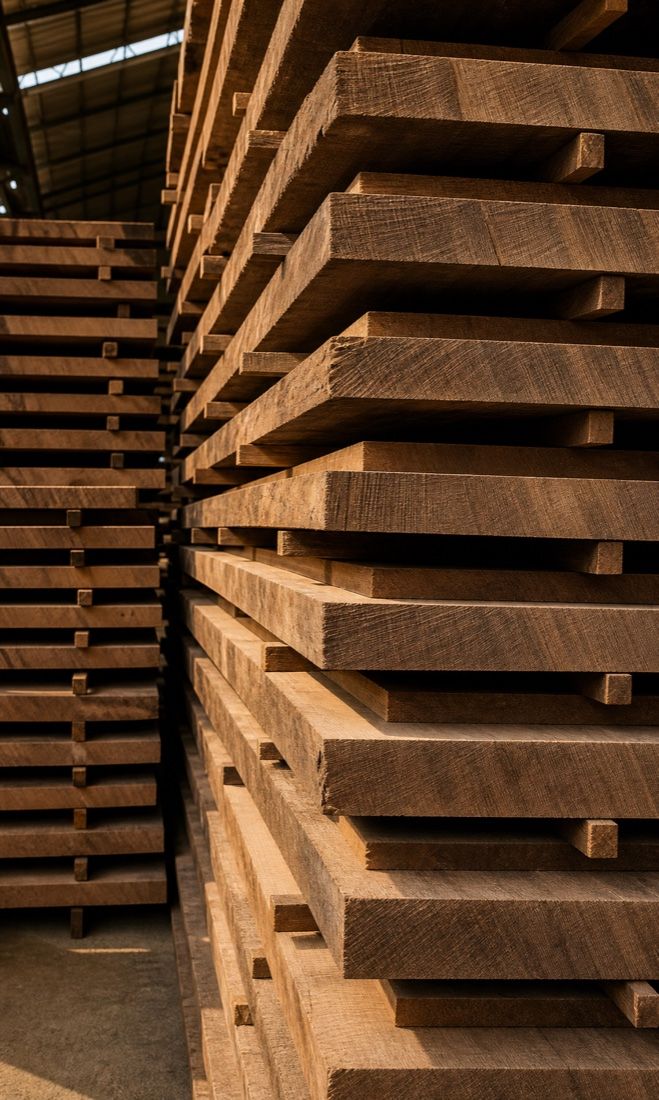
Drying is one of the most important — and most underrated — stages in transforming tropical timber. It defines the dimensional stability of the piece and, consequently, how the material behaves once installed.
Controlling the wood’s moisture means controlling much of the risk of future problems.
Well-dried wood is stable wood: the correct moisture content is the foundation of every good project.
From moisture content to stability
Freshly sawn wood contains a large amount of water. As it loses moisture until it reaches equilibrium with the environment, it moves. If this process happens uncontrolled after installation, warping, cracks and shrinkage appear. Drying anticipates and stabilizes this movement.
Air drying and kiln drying
Air drying is slow and depends on the climate; kiln drying allows precise control of temperature and humidity, reducing the water content to levels suited to the end use in a homogeneous way. The goal is not just to dry quickly, but to dry uniformly, preserving the integrity of the piece.
Conclusion
Understanding drying means understanding why the same species can perform so differently. Wood with controlled moisture content and traceable origin is synonymous with predictability — exactly what architects and builders seek in a quality project.